Friday, May 4, 2012

Rally 'Round the Yards

It's a popular misconception that Camden Yards only comes to life on game days. 

Nothing could be further from the truth, as various parts of the complex are in use every day of the year.  One of the purposes of this blog is to show the many activities which occur in our sports and entertainment facilities, and how they serve the greater community (while also contributing to our bottom line.)

Leasing our facilities is a big part of this effort, and the lots are major producers -- but not just for parking.

This weekend, Lots G and H have been converted to a road course to allow consumers to test the manuverability and safety of Yokahama tires.

Similar road courses have been devised for test driving specific auto brands as well.  Mercedes was here last year, allowing potential clients to road test their newest models.

As part of our partnership with the City of Baltimore Police Department, we make the lots available for officers to receive instruction and be tested for duty on various vehicles. 

This particular exercise was a time trial for motorcycles, which required a tighter course.

Another part of our partnership with the City of Baltimore allows the lots to be used during snow emergencies.  Usually that means the City plows the lots in exchange for allowing nearby residents to park here rather than streets in front of their homes.

However, in the winter of 2010 Lots G and H became the staging area for many outside snow emergency vehicles brought in to help dig Baltimore out. 

(As you can see, the lots were also a dumping area for the mountains of snow that the vehicles removed from other parts of town.)

While Lots G and H have the most open surface, they are not the only ones used for other purposes.

You may remember the "Cash for Clunkers" lawnmover exchange sponsored by the Maryland Department of the Environment.  This interesting concept invited Marylanders to relinquish their gasoline powered, air polluting devices for a generous credit on a new "green" model that uses less energy with fewer emissions.

As you can see from the discarded gas guzzlers, the program was a big success, which prompted a repeat the following year. 

Quite often the lots are leased as a holding area for major trade shows being held at the nearby Convention Center.  Transport vehicles for the Auto and Boat shows stay for the duration of the event, as do commercial exhibit suppliers.

But sometimes the exhibits drop in themselves, as did this Army helicopter bound for a military recruitment event at the Convention Center.  Since it had to be disassembled to fit, Lot C was a good place to strip it down. 

After the show, it was towed back, sans rotors, and reassembled in the same place before reporting to duty.

So while our acres of asphalt may not seem like a facility or venue, they are significant in the success of Camden Yards and many activities taking place in downtown Baltimore.


Thursday, May 3, 2012

Dempsey's Now Open to Public !!!!

The day has finally arrived!  Dempsey's Brew Pub (complete with operating brewery, which we've been admiring since Opening Day) is now officially open to the public on non-game days.

That means everyone can enjoy staring at the walls and reminiscing as we have for the past few weeks.

The website will soon be featuring the menu (which includes those divine rockfish tacos,) so be sure to bookmark this:


Here are the hours of operation:


Non-Game Day                                                           
Sunday to Thursday:                                                     
      
Food Service
Lunch Menu:          11:00am to 3:00pm
Bar Menu:                3:00pm to 5:00p
Dinner Menu:           5:00pm to 10:00pm
                                     
Bar                        11:00am to 11:00pm
                                
Friday and Saturday:
     
Food Service                                             
Lunch Menu:          11:00am to 3:00pm
Bar Menu:                3:00pm to 5:00pm        
Dinner Menu:           5:00pm to 10:00pm

Bar                       11:00am to 1:00am

Game Day                                                                             
Sunday to Thursday:

Food Service
Lunch Menu:          11:00am to 3:00pm
Bar Menu:                3:00pm to 5:00pm
Game Day Menu:     5:00pm to 10:00pm

Bar                        11:00am to 11:00pm
 
Friday and Saturday:      
Food Service                                  
Lunch Menu:          11:00am to 3:00pm
Bar Menu:               3:00pm to 5:00pm
Dinner Menu:          5:00pm to 10:00pm

Bar                      11:00am to 1:00am


Wednesday, May 2, 2012

The Colorful Characters of Camden

We have a great neighborhood here at Camden Yards, with lots of interesting visitors to be seen from the Warehouse Window.  Sometimes they look back, as you can see.

Working one Saturday last October, I was taken aback with the steady stream of ghouls congregating at Camden Station.  It seems the Geppi Entertainment Museum (one of the most fascinating places you could ever visit) was having a zombie jamboree of some sort. 

Part of the celebration was an extreme makeover session where aspiring zombies had decorative designs added by a resident stylist. Then came a zombie parade down Camden Street. 

After a few hours, I adjourned to my favorite watering hole, only to find the zombies had multiplied and were occupying all the barstools.

Zany, perhaps.  But part of the multi generational fun you'll find at Geppi's.

Of course Geppi's is not the only museum with dynamic displays and activities in Camden Station. 

On another Saturday, there was an even more diverse gathering at Sports Legends, the museum associated with the Babe Ruth Birthplace a few blocks away.

Sports Legends has events all the time, from discussions with sports heroes to press conferences and opening historic exhibits.

But this whimsical -- and family oriented -- hoedown is the annual Meet the Mascots soiree.

Such local crowd pleasers as Testudo (Maryland), Doc the Tiger (Towson), Louie from Bowie (Bowie BaySox), True Grit (UMBC Retriever), and The Eagle (Coppin State) joined newcomer Wild Stang (Stevenson) and the Bad Birds of Baltimore (Poe and O) at the popular museum.


Of course, every once in a while you see someone strolling out of Camden Station that doesn't seem to fit either category, like this early morning visitor who was on his way to Washington last March.

We knew in advance he'd be coming, but can only imagine how the regular MARC commuters reacted.

(He'll be back again in 2013, on the 150th anniversary of the Gettysburg Address.) 

The historic railroad station witnessed a lot of activity when the Civil War broke out, but probably none more poignant than when the fallen President passed through one last time as his funeral cortage took him home to Springfield.

So while we never know for sure who might be dropping into Camden Station at any given time, we've learned not to be surprised.  And sometimes, you'll even find us there getting into the fun . . . and history.


Tuesday, May 1, 2012

Gus and the Glove

Wow!!  Nice to hear from someone out there with the same memories about Hoyt Wilhelm and his fierce knuckleball.  (That's Hoyt on the wall at Dempsey's.) 

Not only did his specialty baffle opposing hitters (he even no-hit the Yankees on 99 pitches) but it equally vexed catcher Gus Triandos -- my first Oriole hero.

Gus was a powerful hitter, and one of the early O's stars.  But catching Hoyt Wilhelm was not his idea of a good time behind the plate.

Neither was leading the league in passed balls. There were some games when he would have to chase more than one an inning. 

Taming the knuckleball wasn't an option, because it was a formidable weapon.   I'm not sure what the aerodynamic principle is (something about lack of spin causing wind resistance that made it dip,) but no one -- including Gus -- knew exactly where it would go once it left the mound.

Evidently back then you could customize the Tools of Ignorance.  I'm not sure whose idea it was -- maybe manager Paul Richards? -- but someone came up with the bright idea to build Gus a bigger glove.  A much bigger glove.

So in those early 60's games, when Hoyt Wilhelm got the nod in the bullpen, Gus would trot over to the dugout and retrieve "The Thing."  (I think there were other names for it, but I only remember "The Thing.") 

It looked like an early version of a beanbag chair and seemed to cover most of home plate.  I'm surprised the umpires could see over it.

I don't know if "The Thing" was bequeathed to whoever had to catch Wilhelm when Gus left or not.  I can't imagine MLB would let anyone use such a contraption these days.  (It doesn't even have a logo on it, for heavens sake.)  But I hope it found a home somewhere. 

For you old timers like me who remember Gus and his efforts to corral the knuckleball, here's a picture of what it looked like in comparison to a regular catcher's mitt.

(I think this was taken at Griffith Stadium in DC.  Could be Briggs in Detroit, but look at the tree growing beyond left field.)

So thanks again to Dempsey's for the stirring the memories.  I could honestly spend days in there just staring at the walls and reliving those days of yore.

And please, somebody --  find out what happened to "The Thing."

Growing a Garden of Greats

Every garden starts with a plan, and before that -- a vision.

Here is the O's resident visionary, Janet Marie Smith, explaining to MSA Chairman John Morton III how the Bullpen Picnic Area was to be transformed into a statuary garden honoring Orioles Hall of Famers.

While the model in the foreground offered a glimpse of the concept, it was a little difficult to see past the bulldozers, gravel, and dust at this point from the Warehouse window.

At this point in construction, all you seem to think is "They'll NEVER get this done by Opening Day."

But we always do -- on time, on budget --even if it means round the clock shifts until the last minute.

In this 20th year of Oriole Park, one of the many opportunities to celebrate the O's of yore will be the dedication of statues to the six heroes who entered the Hall of Fame wearing the orange and black.

The statues will be unveiled, one a month, in the order the players were enshrined.

Last Saturday was Frank Robinson's turn. He's seen here with a pre-game crowd of about 500 after the unveiling. His statue depicts him following a long fly ball as it soars into far left field. 

One of the many nice things about the Garden of Greats is that, like Eutaw Street, the mini park is accessible to the public.  The regraded plaza offers a splendid view of the field, which is worth seeing even when there is no game in progress.

We have five more dedications this season, honoring Brooks, Earl, Jim, Eddie and Cal, Jr.  Miniatures of the statues will be distributed to all fans attending the games.

So come see how our garden grows this summer.  It is a wonderful opportunity to relive past heriocs, reminisce about good times on 33rd Street, and build cherished memories of Oriole Park at Camden Yards.


Saturday, April 21, 2012

Still Flying High . . . .

I can see I'm going to be spending most of the summer at Dempsey's, reliving my youth and memories of Memorial Stadium.  Of course, many of those memories came with us to Camden Yards, and here on Dempsey's wall is one of them.

I was actually looking for Gus Triandos when I found him.  Surely Hoyt Wilhelm could not be walled without Gus Triandos (and The Thing, although I couldn't find any pictures of it.  Note to Rick -- find The Thing.)

But seeing Boog suddenly transported me to Junior High (that's what they called it in those days.)  It was early 60's, Kennedy administration, probably Boog's first or second year with the team.  See, he's still wearing #16 and playing in the outfield.  He didn't become #26 the first baseman until Jim Gentile departed.  And most announcers were still calling him "John."

Boog spent his whole career with the Birds and was a real fan favorite.  Although he was known for his love of deep sea fishing, among his hidden talents was outdoor grilling.  So when Oriole Park in Camden Yards opened, it was a stroke of genius to plop Boog and his signature Open Pit Barbeque on the Grand Promenade that was once Eutaw Street.

Boog provided more than great food and a distinctive concept (which was quickly emulated in other ballparks, as many of the landmark elements of Oriole Park were.)  His smoking grill provided the most reliable weather vane for batters trying to analyze the tricky currents blowing down Eutaw.  Despite having the two impressive Birds on top of the scoreboard that were supposed to perform that function, it seemed that the two couldn't agree which way the wind was blowing.  Smart hitters throughout the league quickly figured that Boog's smoke signals were far more trustworthy.

Of course, the biggest part of the appeal was not the heavenly aroma permeating the park or even the yummy fare, but Boog himself.  From day one, he was a fixture at the tent, where you can still find him perched, ready to talk to fans and pose for pictures. 

Boog is our resident link between the days at Memorial Stadium and Camden Yards.  He loves the game.  He loves to talk about the Birds, and he truly enjoys his gig on Eutaw Street.

Occasionally you'll catch him into other things here, like helping to coach in "field days" that some of the O's corporate sponsors for their employees.  For the folks who get to come to Oriole Park for the day, play on the field, and work on their skills with some of the O's legends, it is a real treat. 

Boog seems to enjoy it just as much as they do.  In fact, he seems to enjoy just about everything that has to do with baseball and his beloved O's.

For those of us several stories above Eutaw Street, there is no better harbinger of spring than when he fires up the grill for the season.  The fragrance wafts through an open window and suddenly you realize it is time to play ball again.

Friday, April 20, 2012

Baseball and the Banner

Kudos to our friends and teammates, the Orioles, who are producing a video spot about "The Star-Spangled Banner" to educate fans about the celebrations surrounding the War of 1812 Bicentennial.

Not only does Baltimore have a special relationship with the song we revere as our National Anthem, but so does baseball. It is as much a Major League ritual as exchanging line-ups at home plate.

So how did that come about?
A little online digging produced several anecdotes about "The Star-Spangled Banner" and ball games, some going all the way back to the earliest days, when brass bands serenaded fans with popular melodies.

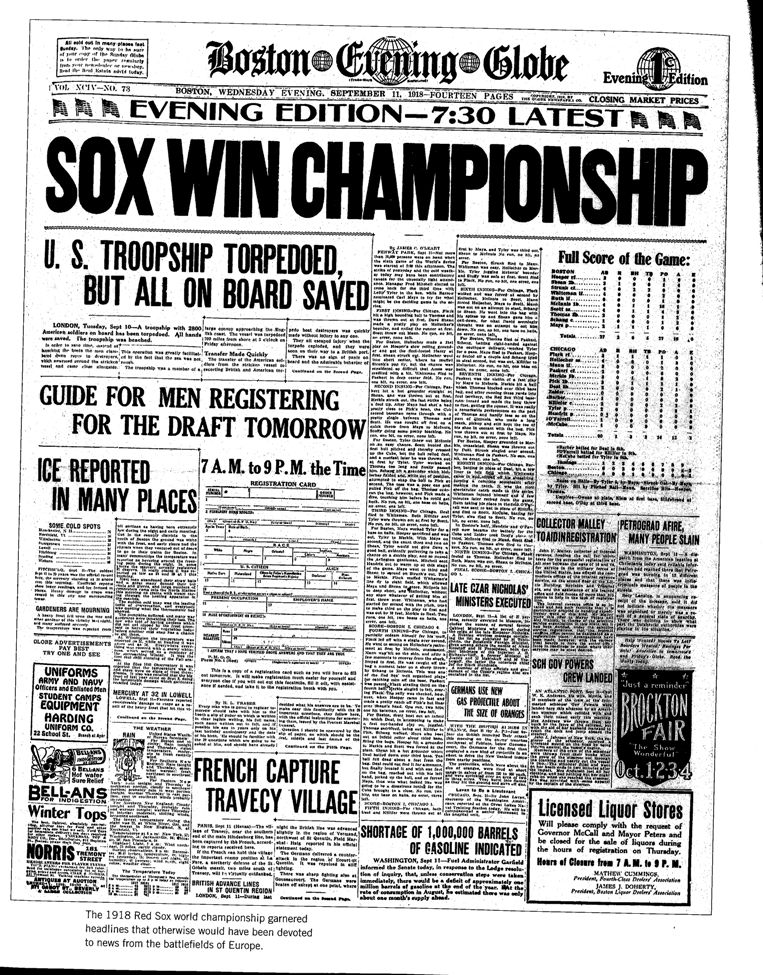
However, there is one particular incident, recounted in the September 6, 1918 New York Times, that describes an episode that may mark the beginning of the treasured tradition.

1918 was a particularly dark time for the United States, which entered World War I the year before. Casualties were devastating, the deadly Spanish Flu was sweeping the nation, and there was social unrest on the home front.

With many players on active duty, the 1918 season was abbreviated, ending on Labor Day. The World Series between the Cubs and Red Sox was the only time the fall classic would be played entirely in September. It opened in Chicago, just one day after a bomb exploded in a federal courthouse – supposedly set by labor activists, anarchists, or a combination thereof.

So it was against this tumultuous background the Series opened September 5th on the South Side of Chicago, where the larger Comiskey Park was leased to accommodate more fans.

However, by the seventh inning stretch, a modest and somewhat indifferent crowd of about 19,000 had been sitting through an unexciting 1-0 pitchers duel.

The restless fans were still shuffling on their feet when the brass band struck up "The Star-Spangled Banner."

Now remember, "The Star-Spangled Banner" was not the National Anthem at the time. It was one of many patriotic melodies performed at public gatherings.

It wasn’t as stately as "Hail Columbia," as singable as "America," or catchy as "Columbia, Gem of the Ocean."  But it had devotees in high places.

In 1889, Secretary of the Navy Benjamin Tracy (seen here with a band aboard the USS "Dolphin") ordered "The Star-Spangled Banner" played at all Navy flag-raising ceremonies.  

In 1916, as war loomed, President Woodrow Wilson, also a fan of the inspiring lyrics, decreed that it be played at military and other appropriate occasions.  Perhaps that prompted what happened next.

The Red Sox were taking the field when the melody began. Third baseman Fred Thomas, an active-duty serviceman on leave from the Navy, immediately stopped. He doffed his cap and turned towards the flagpole in right field, standing at military attention.

The gesture was not lost on his teammates, who likewise faced the flag, hands over hearts. Even the starting pitcher, warming up on the sidelines, stopped tossing as the song played.

The reaction of the crowd is best described in The New York Times:

"First the song was taken up by a few, then others joined, and when the final notes came, a great volume of melody rolled across the field. It was at the very end that the onlookers exploded into thunderous applause and rent the air with a cheer that marked the highest point of the day's enthusiasm."

In the stands was Harry Frazee, the Broadway producer who purchased the Red Sox a few years earlier with money from his theatrical successes. He knew a show-stopping hit when he heard one. He also realized it would work far better as an opening number than buried somewhere in the second act.

So when the Series moved to Fenway Park, Harry did the Cubs one better. He invited World War I veterans as guests, and had the "Star-Spangled Banner" played before the game as a tribute to them. As the impresario predicted, it got things off to a rousing start.

So he repeated it for the remaining games in Boston, to more ovations.

From the Chicago Tribune:

"Another delegation of wounded soldiers and sailors invalided home saw the game, and their entrance on crutches supported by their comrades evoked louder cheers than anything the athletes did on the diamond."
 
The Sox eventually won the Series in six games. The talented southpaw who completed the first game would pitch another shutout in Game 4, establishing a record of 29 scoreless innings in World Series play that stood until Whitey Ford topped it in the 60's.

It was the last time the Sox would win a World Series until 2004.

In 1919, Harry Frazee wanted to produce a promising musical. Cash-strapped because of poor box office receipts during the war, he needed to liquidate assets to finance the show. So he sold his pitcher, who was also his best hitter (but a bit of a problem child) to the New York Yankees for the unheard of sum of $125,000.


Eventually, "No, No Nanette" would be a smash on Broadway. But the Babe from Baltimore would be an even bigger hit in the Bronx, where they built a palace in his honor a few years later.

Still, Harry Frazee can take some credit for producing an overture with an even greater legacy than anything he ever did on the Great White Way.

The "Star-Spangled Banner" became the official National Anthem by an Act of Congress in 1931.

When the country was again at war in 1942, the National Pastime embraced its message of hope, pride, and resilience by playing it at the beginning of every game. The tradition became a treasured part of American, as well as baseball, culture.

Today, of course, you hear the National Anthem at sports events of every kind -- often accompanied by flyovers, fireworks, lasers, and other special effects.  But to those of us who grew up in post-war Maryland, the last two words of the "Star-Spangled Banner" will always be —


"PLAY BALL !!!!!"